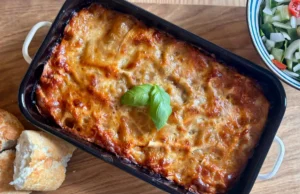
(Traditional Lasagna al Forno)
Lasagna is one of the most iconic dishes in Italian cuisine. In Italian, “lasagna al forno” simply means lasagna baked in the oven, but true restaurant-quality lasagna is defined by technique, balance, and patience, not shortcuts.
This recipe follows a classic Northern Italian approach, using a slow-cooked meat sauce (ragù), a silky white sauce (béchamel), and carefully layered pasta sheets. Unlike many home versions, this method avoids ricotta, producing a lasagna that is richer, smoother, and structurally perfect—just like the kind served in good Italian restaurants.
Key Italian Cooking Terms (Quick Guide)
- Ragù – A slow-simmered meat sauce
- Béchamel / Besciamella – A creamy white sauce made from butter, flour, and milk
- Parmigiano-Reggiano – Aged Italian hard cheese (often called Parmesan)
- Soffritto – Finely chopped onion, carrot, and celery cooked gently as a flavor base
- Al dente – Pasta cooked until tender but still slightly firm
Ingredients
Meat Ragù (Italian Meat Sauce)
- 30 ml / 2 tbsp olive oil
- 450 g / 1 lb ground beef (80/20)
- 225 g / ½ lb ground pork
- 1 small onion, finely diced (about 150 g)
- 1 carrot, finely diced (about 75 g)
- 1 celery stalk, finely diced (about 60 g)
- 4 cloves garlic, minced
- 30 g / 2 tbsp tomato paste
- 240 ml / 1 cup dry red wine
- 800 g / 28 oz crushed tomatoes (San Marzano preferred)
- 240 ml / 1 cup whole milk
- 1 bay leaf
- ½ tsp ground nutmeg (optional but traditional)
- Salt and freshly ground black pepper, to taste
Béchamel Sauce (Creamy White Sauce)
- 70 g / 5 tbsp unsalted butter
- 40 g / 5 tbsp all-purpose flour
- 950 ml / 4 cups whole milk, warmed
- Salt, to taste
- White or black pepper
- Pinch of nutmeg
For Assembly
- 250 g / 9 oz lasagna sheets (12–14 sheets)
- 120 g / 1 cup freshly grated Parmigiano-Reggiano
- 100 g / 1 cup low-moisture mozzarella, grated (optional but common in restaurants)
- Butter for greasing the dish
Step 1: Make the Ragù (Foundation of Flavor)
- Heat olive oil in a heavy-bottomed pot over medium heat.
- Add onion, carrot, and celery (soffritto). Cook gently for 8–10 minutes until soft and fragrant, not browned.
- Add garlic and cook for 30 seconds.
- Add ground beef and pork. Cook until fully browned, breaking the meat finely.
- Stir in tomato paste and cook until deep red.
- Pour in red wine and simmer until reduced by half.
- Add crushed tomatoes, milk, bay leaf, nutmeg, salt, and pepper.
- Simmer uncovered on low heat for 90 minutes, stirring occasionally.
✔ The finished ragù should be thick, cohesive, and rich—not watery.
Step 2: Prepare the Béchamel Sauce
- Melt butter over medium heat.
- Whisk in flour and cook for 1–2 minutes (this mixture is called a roux).
- Gradually whisk in warm milk.
- Cook, stirring constantly, until smooth and thick enough to coat the back of a spoon.
- Season with salt, pepper, and nutmeg.
Step 3: Prepare the Pasta
- For dried lasagna sheets, boil in well-salted water until just shy of al dente (1–2 minutes less than package instructions).
- Drain and lay flat on a clean towel.
- Thin fresh pasta sheets can be used without boiling.
Step 4: Assemble the Lasagna
Preheat oven to 190°C / 375°F.
Butter a 23 × 33 cm / 9 × 13-inch baking dish.
Layering Order (repeat 4–5 times):
- Thin layer of ragù
- Pasta sheets
- Ragù
- Béchamel
- Parmigiano (and mozzarella, if using)
Finish with béchamel, Parmigiano, and small dots of butter on top.
Step 5: Bake
- Cover loosely with foil.
- Bake for 30 minutes.
- Remove foil and bake another 20–25 minutes, until golden and bubbling.
- Remove from oven and rest for 15–20 minutes before serving.
🟢 Resting allows the layers to set and ensures clean slices.
Serving Methods & Presentation (Restaurant-Style)
Resting Is Essential
Lasagna should never be served straight from the oven. Resting:
- Firms the layers
- Improves texture
- Prevents the lasagna from collapsing
Restaurants often serve lasagna warm rather than piping hot for best structure and flavor.
Portioning Like a Professional
- Use a sharp knife, wiped clean between cuts
- Cut into neat rectangles
- Yield:
- 8 generous portions
- 10–12 refined plated servings
Lift slices using a wide spatula for clean edges.
Plated vs Family-Style Service
Plated (Formal / Restaurant-Style):
- Serve one slice centered on a warm plate
- Spoon a small amount of extra ragù on the side
- Finish with freshly grated Parmigiano-Reggiano and a light olive oil drizzle
Family-Style (Traditional):
- Serve directly from the baking dish
- Pass Parmigiano at the table
- Simple, communal, and authentic
What to Serve With Lasagna
Classic pairings:
- Simple green salad with lemon or red-wine vinaigrette
- Crusty bread (served on the side)
- Roasted vegetables such as zucchini or carrots
Wine pairings:
- Chianti, Sangiovese, or Montepulciano
- Non-alcoholic: sparkling water or lightly sweetened iced tea
Storage & Make-Ahead Tips
- Refrigerate leftovers up to 4 days
- Freeze (baked or unbaked) up to 2 months
- Reheat covered at 160°C / 325°F until warmed through
- Rest again briefly before serving
The Art of the Layer
Beyond the technical steps, mastering lasagna is a lesson in the Italian philosophy of “L’arte della semplicità”—the art of simplicity. In Northern Italy, specifically Emilia-Romagna, lasagna isn’t about how much cheese you can pile on top; it is about the harmony between the components. Each layer should be thin and delicate, allowing the sweetness of the soffritto and the silkiness of the besciamella to shine through without one overpowering the other.
When you prepare this dish, you are engaging in a culinary ritual that has spanned generations. For the best cultural experience, remember that lasagna is often considered a “Sunday dish”—one meant to be prepared leisurely while the kitchen fills with the scent of simmering wine and meat. If you have the time, try making the ragù a day in advance; the flavors will mature and deepen overnight, resulting in a dish that is truly more than the sum of its parts.