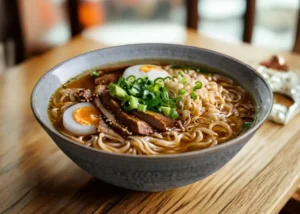
If you love ramen, you already know the reputation of tonkotsu. Deeply creamy, rich with pork flavor, and unapologetically indulgent, it’s the kind of broth that feels like a warm hug at the end of a long day. Traditionally, that depth comes at a cost: 12 to 18 hours of nonstop boiling, constant skimming, and a kitchen that smells like a ramen shop for days.
Great in theory. Less great on a weeknight.
The good news? You can achieve authentic, restaurant-quality tonkotsu at home in a fraction of the time. This method uses a pressure cooker, a rolling boil, and a clever emulsification trick to deliver the signature milky broth—without sacrificing flavor or sanity.
This is a shortcut, not a compromise.
How This Shortcut Works
Classic tonkotsu relies on prolonged boiling to:
- Extract collagen and gelatin from pork bones
- Break down fats
- Emulsify everything into that iconic cloudy broth
We speed up the process by:
- Pressure cooking the bones to extract flavor and gelatin fast
- Boiling uncovered to loosen fats
- Blending the broth to force emulsification
The result? A rich, opaque, creamy broth that tastes like it’s been simmering all day—because chemically, it kind of has.
1. The Soup Base (Tonkotsu Broth)
This is the foundation of your bowl. Treat it with care.
Ingredients
- 2 kg pork bones
(Femurs, hip bones, or any bones with marrow, fat, and a little meat) - 3.5 liters water
(Enough to cover the bones by about 2–3 cm / 1 inch) - Aromatics(added later):
- ½ onion
- A handful of garlic cloves
- A few chunks of cabbage
Step 1: The Soak & Pre-Boil (Do Not Skip)
This step keeps your broth clean, white, and balanced.
- Soak the bones in cold water for 2–4 hours, changing the water once or twice.
This removes myoglobin (the dark “red stuff”) that causes bitterness. - Drain the bones and place them in a large pot.
- Cover with fresh water and bring to a rapid boil for 5–10 minutes.
- Stir aggressively, skim off gray foam, then drain.
- Rinse and scrub the bones until they’re clean and pale.
This process is what separates a refined tonkotsu from a muddy one.
Step 2: Pressure Cook for Extraction
- Transfer cleaned bones to your pressure cooker.
- Add 3.5 liters of fresh water.
- Cook on high pressure for 1 hour.
- Allow a natural pressure release if possible.
At this stage, the broth will look golden and thin—but don’t worry. The magic comes next.
Step 3: Emulsification & Creaminess
- Add the onion, garlic, and cabbage to the pot.
- Bring the broth to a rolling boil, uncovered, for 1 hour.
- Right before serving, remove large solids.
- Use an immersion blender directly in the pot and blend thoroughly.
This step emulsifies fat, collagen, and liquid into that signature milky-white tonkotsu texture.
2. The Shoyu Tare (Seasoning Base)
The broth provides body—but the tare gives the ramen its soul. This is where salt, umami, and depth come together.
Ingredients
- 150 ml water
- 125 ml koikuchi shoyu (standard Japanese soy sauce)
- 25 ml sake
- 15 ml mirin
- 1 g instant shrimp dashi powder (optional but excellent)
- 9 g MSG (crystallized umami extract)
- 18 g sea salt (Hawaiian or similar)
Method
- Combine all ingredients except salt in a small pot.
- Bring just to a gentle simmer.
- Turn off the heat.
- Stir in salt until fully dissolved.
Set aside. This will keep well in the fridge for weeks.
3. Fat, Noodles & Toppings (The Finish Line)
Ramen lives or dies in the details.
Aroma Oil
- Lard (homemade if possible, or high-quality store-bought)
This adds shine, richness, and that unmistakable ramen-shop aroma.
Noodles
- Fresh ramen noodles
- Cook for about 1 minute (or according to package)
Always cook noodles separately and just before serving.
Classic Toppings
- Chashu (braised pork belly)
- Green onions
- Rehydrated wood ear mushrooms (kikurage)
- Menma (seasoned bamboo shoots)
How to Assemble the Bowl
- Add 20 ml shoyu tare to your serving bowl.
- Add 10 ml lard.
- Pour in hot, blended tonkotsu broth.
- Add cooked noodles and gently fold them into the soup.
- Arrange toppings neatly on top.
- Serve immediately.
Tonkotsu ramen is best enjoyed immediately after assembly, when the broth is fully emulsified and the noodles are perfectly springy. Always warm your serving bowls first with hot water—this helps maintain temperature and preserves the creamy texture of the broth.
Begin by seasoning the bowl with the shoyu tare and aroma oil, then pour in the piping-hot tonkotsu broth. Add freshly cooked noodles and gently loosen them with chopsticks to evenly coat each strand. This ensures the noodles absorb flavor without overcooking.
Arrange toppings neatly rather than piling them on. Place chashu (braised pork belly) partially submerged so it warms gently, scatter green onions for freshness, and finish with kikurage (Wood ear mushrooms) or menma (fermented and seasoned bamboo shoots) for contrast. Serve with chopsticks and a soup spoon, and enjoy while hot for the best balance of richness, aroma, and texture.
Creamy. Deep. Soul-satisfying.
And best of all—you’ll want to make it again.