
If you have ever watched a thin, watery gravy transform into a silky sauce or seen firm rice grains turn into a creamy pudding, you have witnessed one of the most important reactions in food science: starch gelatinization.
This process is the “magic” behind the texture of countless carbohydrate-based dishes. Understanding how starch interacts with heat and water allows you to control thickness, mouthfeel, and overall texture with confidence.
What Is Starch?
Before we explore the transformation, we need to understand the raw material. Starch is how plants store energy. It exists inside plant cells as tiny, semi-crystalline structures known as granules.
Within each granule are two glucose-based polymers:
Amylose – Mostly long, linear chains that play a major role in gel formation and firming.
Amylopectin – Highly branched chains that contribute significantly to viscosity and stability.
In their raw state, starch granules are insoluble in cold water. They may disperse temporarily when stirred, but they do not dissolve or thicken a liquid without heat.
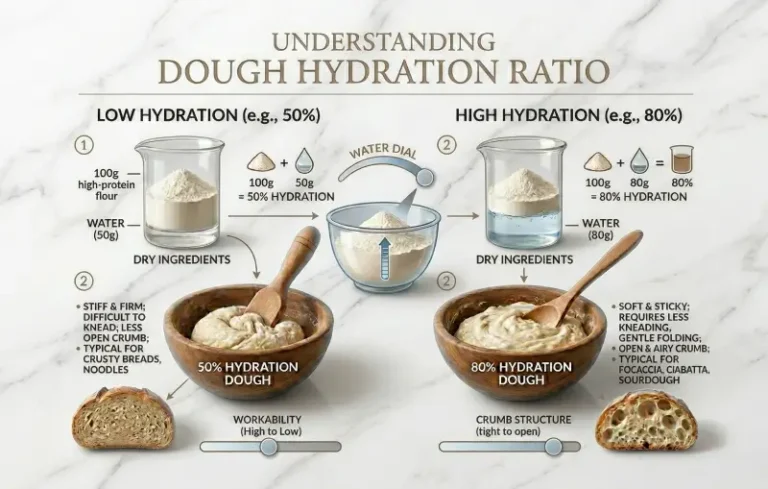
Related article: Hydration Ratios in Dough
The Process: From Granule to Thickened Sauce
Gelatinization occurs when starch is heated in the presence of water. It is best understood as a gradual, multi-stage transformation.
Step 1: Hydration and Swelling
As starch is heated in liquid, water begins to penetrate the granules. Heat weakens the internal hydrogen bonds that maintain their semi-crystalline structure. Water first enters the less organized (amorphous) regions, and the granules begin to swell.
This swelling increases viscosity even before full gelatinization is reached.
Step 2: Gelatinization Range
As temperature rises into the gelatinization range — commonly between 60–75°C (140–167°F) for many cereal starches, though it varies by source — the granules swell dramatically.
At this stage:
- Crystalline regions begin to melt.
- Granules expand to several times their original size.
- Some amylose begins to leach into the surrounding liquid.
Granule rupture can occur under high heat or vigorous stirring, but complete “bursting” is not required for thickening. Swelling and molecular disruption are the primary drivers of viscosity.
Step 3: Thickening and Network Formation
As more amylose leaches out, the long chains begin to entangle with one another and interact with water molecules. This creates a network that traps water and increases thickness.
The sauce thickens noticeably during heating. However, a firmer gel structure develops more fully as the mixture cools and starch molecules begin to reassociate.
(Continue reading: Retrogradation: Why Bread Goes Stale)
Factors That Influence Gelatinization
Not all starches behave the same way. The final texture depends on several environmental factors.
Temperature
Different starches gelatinize at different temperatures. For example:
- Potato starch typically thickens at slightly lower temperatures.
- Cornstarch and wheat starch gelatinize slightly higher.
The source of the starch determines its behavior.
Related article: Comparing Common Kitchen Starches
Agitation (Stirring)
Stirring helps distribute starch evenly and prevents clumping during heating. However, excessive mechanical shear after the granules have swollen can rupture them, potentially reducing viscosity over time.
The thinning effect is usually due to physical breakdown of swollen granules rather than chemical destruction of starch chains.
Sugar
Sugar competes with starch for available water. Because of this, high-sugar mixtures require higher temperatures to gelatinize and may produce a softer or weaker gel.
This is why fruit pie fillings often need careful heat management.
Explore more: The Science of Sugar
Acidity
Acidic ingredients such as lemon juice or vinegar can hydrolyze starch molecules if heated for extended periods. This weakens thickening ability.
For best results, acidic components are often added after gelatinization has occurred.
Culinary Applications
Understanding starch gelatinization unlocks control in the kitchen.
The Perfect Roux
When flour is coated in fat before liquid is added, the fat helps disperse starch granules evenly and prevents clumping. As liquid is incorporated and heated, gelatinization occurs smoothly.
As a roux darkens, its thickening power decreases because prolonged heat partially degrades starch.
Creamy Rice Pudding
As rice cooks slowly in liquid, starch gradually gelatinizes and leaches from the grains. This natural release of starch thickens the mixture into a creamy consistency without added thickeners.
(Read more: Rice Pudding and Starch Gelatinization)
Pasta Texture
The “al dente” bite of properly cooked pasta results from incomplete starch gelatinization at the center of the noodle. The surrounding protein matrix (gluten) also helps regulate water penetration, contributing to texture.
What Happens After: Retrogradation
Once a starch-thickened mixture cools, the molecules begin to reorganize into more ordered structures. This process is called retrogradation.
As amylose and amylopectin chains realign and form new crystalline regions, the texture becomes firmer. This is why:
- Bread becomes stale over time.
- Refrigerated rice turns firm.
- Chilled sauces may set more firmly than when hot.
Conclusion
Starch gelatinization is the foundation of texture in countless dishes. Whether you are thickening a soup, baking bread, or cooking rice, you are managing the interaction between starch granules, heat, and water.
By understanding how swelling, molecular disruption, and network formation occur, you gain precise control over consistency and structure.
What appears to be culinary magic is, in reality, applied carbohydrate chemistry.
Related article: How Carbohydrates Actually Build the Food We Love