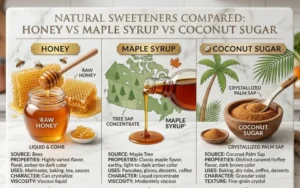
In the pursuit of healthier or more “whole” food systems, many people are moving away from refined white sugar (sucrose) toward natural sweeteners. However, from a food science perspective, a sweetener is never just “sweet.” Each option brings a unique ratio of glucose, fructose, and sucrose, along with varying levels of minerals, moisture, organic acids, and other bioactive compounds.
Understanding the molecular makeup of these sweeteners is essential for managing fermentation, browning reactions, moisture migration, and structural balance in baking systems. (For deeper context, see Fermentation and Carbohydrates and Flour Types Explained.)
1. Honey: The Enzymatic Sugar Matrix
Honey is a supersaturated sugar solution composed primarily of fructose (≈38%), glucose (≈31%), water (≈17–20%), and small amounts of sucrose, organic acids, enzymes, and minerals.
Hygroscopic Nature
Honey is more hygroscopic than table sugar due largely to its high fructose content. It attracts and retains moisture, which can help slow staling in baked goods. However, bread staling is driven primarily by starch retrogradation (especially amylopectin recrystallization), so honey delays firming mainly by retaining moisture rather than stopping starch chemistry.
See: Retrogradation: Why Bread Goes Stale.
Acidity and Leavening
Honey is naturally acidic (average pH around 3.4–4.5). In baking, this acidity reacts with baking soda to produce carbon dioxide gas, contributing to rise. This reaction is part of chemical leavening systems, not microbial fermentation.
Fructose Intensity
Fructose has a higher relative sweetness than sucrose. Because honey contains more fructose than glucose, it tastes sweeter than table sugar on a per-weight basis, allowing slight reductions in quantity.
Browning Behavior
Honey browns more quickly than sucrose due to its high fructose content, which readily participates in both caramelization and the Maillard reaction.
2. Maple Syrup: The Diluted Sucrose System
Pure maple syrup is composed primarily of sucrose (≈60–67%) dissolved in water, with small amounts of glucose, fructose, organic acids, amino acids, and minerals.
Maillard Reaction
While maple syrup contains trace amino acids and minerals, its browning in baking is influenced largely by reducing sugars formed during sap boiling. Darker grades contain more concentrated flavor compounds that deepen roasted and caramel notes.
For a broader explanation of browning chemistry, see: Starch Gelatinization Explained (for moisture balance context) and Flour Types Explained (for protein-sugar interactions).
Structural Stability
Because maple syrup is largely sucrose-based, it behaves similarly to granulated sugar in terms of crystallization potential once concentrated. However, its high water content means it must be reduced significantly to form firm candies or stable glazes.
Water Content
Maple syrup is approximately one-third water. When substituting for dry sugar, reducing other liquids is essential to maintain proper dough viscosity and starch gelatinization balance.
See: Starch Gelatinization Explained.
3. Coconut Sugar: The Minimally Refined Sap Sugar
Coconut sugar is produced by evaporating sap from the coconut palm. It is composed primarily of sucrose (≈70–80%) with minor glucose, fructose, and inulin-type fibers.
Glycemic Index Claims
While it may have a somewhat lower glycemic response than refined sugar due to minor inulin content, the difference is modest. It remains predominantly sucrose and should be treated nutritionally as a sugar.
Inulin Content
It contains small amounts of inulin, a soluble fiber that may slightly slow glucose absorption.
Physical Texture
Coconut sugar resembles brown sugar in granule size but lacks molasses-derived moisture. It can produce slightly drier baked goods unless additional liquid or fat is added.
Flavor Profile
It does not taste like coconut; instead, it has caramel and butterscotch notes due to Maillard and caramelization reactions during sap heating.
4. Dates and Date Sugar: The Whole-Fruit System
Dates provide sweetness primarily from glucose and fructose, along with substantial fiber, minerals, and phytochemicals.
The Fiber Effect
Whole date paste contains both soluble and insoluble fiber. This fiber competes for water in a batter, altering viscosity and moisture distribution. The result is often a denser, more moist, and sometimes fudgier texture.
This effect becomes particularly important when working with gluten-free systems.
See: Alternative Flours (Cassava, Chickpea, Rice).
Date Sugar
This is simply dried, ground dates. Because it consists of microscopic fruit particles rather than crystallized sugar, it does not dissolve fully in water. It works best in thick batters—not in clear syrups.
Technical Conversion Guide: Swapping Solids for Liquids
Substituting sweeteners is a structural adjustment. Liquid sweeteners introduce water, invert sugars, and acids, all of which influence gluten development, browning reactions, and starch behavior.
For foundational structure science, see: Flour Types Explained.
Converting to Honey
Ratio: Replace 1 cup sugar with 3/4 cup honey.
Moisture: Reduce other liquids by about 1/4 cup.
Heat: Lower oven temperature by about 15°C (25°F) to prevent over-browning.
Acidity: Add about 1/4 teaspoon baking soda per cup of honey to balance acidity and support leavening.
Converting to Maple Syrup
Ratio: Replace 1 cup sugar with 3/4 cup maple syrup.
Moisture: Reduce other liquids by about 3 tablespoons.
Tip: Darker grades provide stronger flavor and perform well in heavy bakes.
Converting to Coconut Sugar
Ratio: 1:1 replacement by volume.
Moisture Adjustment: If replacing brown sugar, consider adding 1–2 tablespoons of extra liquid or fat.
Converting to Date Paste
Ratio: 1:1 by volume.
Hydration: Usually no need to reduce liquids, as the fiber absorbs moisture.
This can be particularly helpful when working with gluten-free flour systems.
See: Alternative Flours (Cassava, Chickpea, Rice).
Texture Impact: Expect denser, softer structures rather than light, aerated crumb.
Conclusion
Mastering natural sweeteners is about more than replacing white sugar—it’s about understanding sugar chemistry within a complete baking system. Honey increases hygroscopicity and accelerates browning. Maple syrup contributes sucrose with added moisture and flavor compounds. Coconut sugar behaves similarly to brown sugar but with less inherent moisture. Dates introduce fiber and alter water distribution.
When paired intentionally with the right flour system, fat content, and leavening method, these sweeteners allow precise control over texture, structure, and shelf life.
For deeper structural understanding, continue with: