Table of Contents
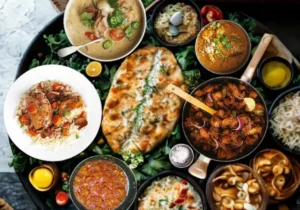
North Indian food culture is a masterclass in culinary evolution. It isn’t just a collection of recipes; it’s a living map of the region’s geography, its complex history of invasions, and its deeply rooted spiritual traditions. To understand why a North Indian meal looks the way it does, we have to look at the layers of history that built it.
1. The Ancient Roots: Earth and Spirit
The foundation of North Indian cuisine lies in the fertile Indo-Gangetic plains. Historically, this was a land of wheat, barley, and lentils. Unlike the rice-dominant south, the north’s climate favored sturdy grains, giving birth to the endless variety of flatbreads—from the simple phulka to the complex paratha.
- Ayurvedic Influence: Early North Indian diets were heavily influenced by Ayurvedic principles, focusing on Sattvic (pure) foods. This meant a heavy reliance on dairy—ghee, milk, and curd—which remain the soul of the North Indian kitchen today.
- Vegetarianism: While meat was consumed in ancient Vedic times, the rise of Buddhism and Jainism in the region solidified a sophisticated culture of vegetarianism that persists in states like Rajasthan and Haryana.
2. The Islamic Influence and the Persian Bloom
The most dramatic shift in North Indian food history occurred with the arrival of Central Asian and Persian influences, culminating in the Mughal Empire. This era introduced the “Mughlai” style, which transformed food from mere sustenance into an art form.
- The Tandoor: While clay ovens existed earlier, the Mughals refined the use of the tandoor for meats and breads like naan.
- Spices and Aromatics: The Persians brought the use of saffron, dried fruits, and nuts. They introduced the concept of slow-cooking meat in its own juices (dum pukht), leading to the creation of the Biryani and the Korma.
- New Ingredients: Through trade routes, ingredients like tomatoes, chilies, and potatoes arrived via the Portuguese, eventually becoming so central to North Indian cooking that it’s hard to imagine a “traditional” curry without them today.
3. Regional Identities: The Rugged and the Royal
As North Indian culture branched out, distinct regional “sub-cultures” emerged:
| Region | Historical Driver | Key Characteristic |
| Punjab | Agricultural abundance | Hearty, robust flavors; heavy use of butter and cream; the “dhaba” culture. |
| Rajasthan | Arid climate & War | Food that could last days without reheating; use of milk/buttermilk instead of water (e.g., Ker Sangri). |
| Awadh (Lucknow) | Princely patronage | Extreme refinement; the “melt-in-the-mouth” Galouti kebab; focus on aroma (ittar). |
| Kashmir | Persian/Central Asian links | The Wazwan (a 36-course ritual meal); use of yogurt and fennel; absence of onion/garlic in Pandit cuisine. |
4. The Colonial Legacy and Modernity
The British Raj left its mark not just through tea culture, but through the “Railroad Curry.” As the British moved across the North, they adapted local spices to their palate, leading to the creation of Anglo-Indian dishes.
Post-Independence, the 1947 Partition brought a massive influx of Punjabi refugees to Delhi. This era birthed modern staples like Butter Chicken and Dal Makhani—dishes created by enterprising chefs to make tandoori chicken more succulent for the urban masses.
The takeaway: North Indian food is a “melting pot” in the most literal sense. It is a cuisine that absorbed the fire of the Persians, the discipline of the ancient monks, and the heartiness of the Punjabi farmer.