Table of Contents
Nothing beats the joy of freshly churned ice cream made exactly to your taste. However, with prices ranging from $35 to $600 and a wide array of freezing technologies available, picking the wrong machine can lead to disappointing, slushy results.
To help you invest wisely and achieve the perfect scoop, this guide covers the essential factors you need to know before buying your first home ice cream maker.
Types of Ice Cream Machines
The single most important thing to understand before buying is that there are three fundamentally different types of ice cream machines. Each works differently, costs differently, and suits different lifestyles.
Pre-freeze Bowl Machines (Freezer Bowl Type)
These are the most popular entry-level machines. They come with a double-walled bowl filled with a liquid coolant. You freeze the bowl in your freezer for 12–24 hours before use, then attach it to the machine and churn your mixture.
Pros:
- Affordable (typically $35–$180)
- Compact and lightweight
- Easy to use and clean
Cons:
- You must plan ahead — the bowl needs overnight freezing
- You can only make one batch per session (the bowl warms up)
- Bowl takes up significant freezer space
Best for: Beginners, occasional users, small households
Popular examples: Cuisinart ICE-21, Ninja Creami (uses a different mechanism but similar concept)
Self-Refrigerating / Compressor Machines
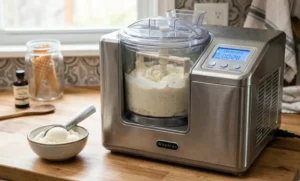
These machines have a built-in compressor — like a mini refrigerator — that freezes your mixture on demand. No pre-freezing required.
Pros:
- Make multiple batches back-to-back
- No waiting — just pour and churn
- More consistent results
- Better for experimentation
Cons:
- Significantly more expensive ($240–$960+)
- Heavier and bulkier
- Higher electricity consumption
Best for: Ice cream enthusiasts, large families, frequent churners, home cooks who experiment regularly
Popular examples: Cuisinart ICE-100, Whynter ICM-200LS, Breville Smart Scoop
Attachment-Style Machines
Some brands like KitchenAid sell ice cream bowl attachments that work with their stand mixers. If you already own the mixer, this is a cost-effective option.
Pros:
- Affordable if you already own a compatible stand mixer
- Takes up less counter space (uses existing equipment)
Cons:
- You still need to pre-freeze the bowl
- Limited to one batch per session
- Performance varies compared to dedicated machines
Best for: KitchenAid owners looking to expand their machine’s utility
Decide What You Want to Make
Before buying, think carefully about what frozen treats you actually want to create. Not all machines handle every type equally well.
| Frozen Treat | Fat Content | Churning Need | Best Machine Type |
|---|---|---|---|
| Classic ice cream | High | Medium | Any |
| Gelato | Medium | Low (slow churn) | Compressor preferred |
| Sorbet | None | Medium | Any |
| Frozen yogurt | Low–Medium | Medium | Any |
| Soft serve | Medium | High | Compressor |
| Sherbet | Low | Medium | Any |
If you’re primarily interested in dairy-free, vegan, or low-fat frozen desserts, know that lower-fat bases can sometimes have icier, less creamy textures — look for machines with faster churning speeds to compensate.
Capacity: How Much Ice Cream Do You Actually Need?
Home ice cream machines typically range from 0.9 litres to 2.5 litres per batch.
| Small (under 1 L) | Good for 2–3 servings. Ideal for single users or couples |
| Medium (1 – 1.5 L) | Most common size. Good for a family of 3–4 |
| Large (1.5 – 2.5 L) | Great for larger families or entertaining guests |
One important thing to remember: never fill the bowl more than two-thirds full. Ice cream expands as it churns and freezes — overfilling leads to overflow and uneven results.
The Freezing Time Factor
This is something many first-time buyers overlook entirely.
- Pre-freeze bowl machines require the bowl to be frozen for 12–24 hours before use. This means you need to plan a day ahead, and the bowl must always be in your freezer, ready to go. If you have a small freezer, this can be impractical.
- Compressor machines are ready in minutes. You can decide to make ice cream on a whim and have it ready in 20–40 minutes.
- Churning time typically takes 20–45 minutes regardless of machine type.
Ask yourself honestly: Am I the type of person who plans dessert 24 hours in advance? If not, a compressor machine may be worth the extra cost.
Build Quality and Materials Matter
The durability of your machine depends heavily on its construction:
- Mixing paddle/dasher:
- Look for stainless steel or heavy-duty plastic dashers. Cheap dashers flex under resistance and can crack over time.
- Bowl material:
- Stainless steel bowls are more durable and easier to clean than plastic ones.
- Motor power:
- A more powerful motor (look for 100W+) handles thick, dense mixtures better without straining or stopping mid-churn.
- Lid design:
- A transparent lid lets you monitor the churning process without releasing cold air.
Cheap machines with underpowered motors often stop churning when the mixture gets thick — right at the point when you need them most.
Noise Levels
Ice cream machines aren’t silent. The churning mechanism makes a consistent humming or whirring noise for 20–45 minutes per batch.
- Basic pre-freeze machines are generally moderate in noise (similar to a blender on low)
- Compressor machines tend to be louder due to the refrigeration compressor running simultaneously
If noise is a concern (open-plan homes, sleeping children, apartments with thin walls), read user reviews specifically about noise levels before committing to a model.
Ease of Cleaning
Ice cream contains dairy, fat, and sugar — ingredients that can be stubborn to clean. Before buying, check:
- Are the parts dishwasher safe?
- Many bowls and dashers are, which is a big convenience.
- How many parts does it have?
- Fewer removable components = faster cleaning.
- Is there a drain plug?
- Some compressor machines have drain plugs for the bowl, making rinsing easier.
- Does the machine have hard-to-reach corners?
- These are a nightmare with creamy residue.
The easier the cleanup, the more likely you’ll actually use the machine regularly.
Storage and Countertop Footprint
Ice cream machines can take up a surprising amount of space. Consider:
- Pre-freeze bowl machines:
- These are compact but the bowl must live in your freezer permanently (or be brought out 24 hours before use)
- Compressor machines:
- These are large and heavy — often weighing 10–15 kg. They’re not something you’ll easily move in and out of a cupboard
- Countertop space:
- Compressor machines often need to stay on the counter permanently
Measure your available countertop or cupboard space before purchasing. A machine you can’t conveniently access is a machine you won’t use.
Budget: Getting the Right Value
Here’s a realistic price breakdown to help set expectations:
| Budget Range | What You Get |
|---|---|
| Under $35 | Basic pre-freeze bowl machine. Good for occasional use. Limited durability. |
| $35–$180 | Mid-range pre-freeze machines with better build quality, branded reliability (Cuisinart, Hamilton Beach) |
| $180–$360 | Entry-level compressor machines. No pre-freezing needed. Multiple batches. |
| $360–$960+ | Premium compressor machines with precision temperature control, professional-grade results |
Pro tip: Don’t buy the cheapest machine hoping to upgrade later. The jump from a pre-freeze bowl to a compressor machine is substantial — it’s better to decide upfront which category suits your lifestyle and invest accordingly.
Key Features Worth Paying For
When comparing models, these features genuinely add value:
| Feature | What It Does | Priority |
|---|---|---|
| Automatic Shut-Off | Stops churning when the mixture reaches the right consistency | 🔴 Must-Have |
| Transparent Lid | Monitor progress without lifting the lid and releasing cold air | 🔴 Must-Have |
| Adjustable Churning Speed | Slower speeds produce denser gelato; faster speeds create airier ice cream | 🟡 Nice-to-Have |
| Built-in Timer | Prevents over-churning so you get consistent texture every batch | 🟡 Nice-to-Have |
| Ingredient Chute in Lid | Add mix-ins (chocolate chips, fruit, nuts) mid-churn without opening the machine | 🟡 Nice-to-Have |
| Keep-Cool / Hardening Mode | Keeps finished ice cream at ideal texture while you prepare toppings | 🟢 Enthusiast Upgrade |
Don’t Forget the Recipes and Learning Curve
Even with the best machine, great ice cream requires good recipes. Ice cream science involves understanding:
- Fat content:
- More fat = creamier texture
- Sugar ratios:
- Too little sugar = icy; too much = won’t freeze properly
- Chilling the base:
- Your mixture should be cold (ideally 39°F / 4°C or below) before churning for best results
- Stabilizers:
- Ingredients like egg yolks, cornstarch, or guar gum improve texture significantly
Budget time for experimentation. Your first batch may not be perfect — and that’s completely normal. The learning curve is part of the fun.
Warranty and After-Sales Support
Ice cream machines have moving parts, compressors, and electrical components that can fail. Before buying:
- Look for a minimum 1-year warranty (premium compressor models often offer 2–3 years)
- Check whether the brand has a service center in your region
- Read reviews for long-term reliability — not just first impressions
- Check if replacement parts (especially dashers and bowls) are available to purchase separately
Final Buying Checklist
Before you hit “Add to Cart,” run through this quick checklist:
- Have I decided between a pre-freeze bowl vs. compressor machine?
- Does the capacity match my household size?
- Do I have freezer space (for pre-freeze bowls) or counter space (for compressors)?
- Is the motor powerful enough for dense mixtures?
- Are the components easy to clean?
- Does it have the features I actually need?
- Is it within my budget, including the value it offers long-term?
- Does it have a good warranty and accessible support?
Conclusion
Buying an ice cream machine is an exciting investment — one that pays dividends in endless customisation, healthier ingredients, and the sheer joy of making something delicious from scratch. But the right machine for your neighbour may be completely wrong for you.
Take the time to honestly evaluate how often you’ll use it, what you want to make, how much space you have, and how much you’re willing to spend. If you’re a casual user who plans desserts a day in advance, a quality pre-freeze bowl machine is all you need. If you’re a passionate home cook who wants to churn on a whim, a compressor machine will change your kitchen life.
Either way, you’re about to embark on one of the most delicious hobbies possible. Happy churning!
Frequently asked questions (FAQ)
A pre-freeze bowl machine is best for beginners — it’s affordable, easy to use, and widely available. Brands like Cuisinart offer reliable entry-level models under $100.
Churning takes 20–45 minutes regardless of machine type. However, pre-freeze bowl machines require an additional 12–24 hours of bowl freezing beforehand.
If you make ice cream frequently or want back-to-back batches without planning ahead, yes — a compressor machine is worth the investment. For occasional use, a pre-freeze bowl machine is sufficient.
Yes. Most home ice cream machines handle dairy-free bases like coconut milk, oat milk, or almond milk. Just note that lower-fat bases may produce icier textures — look for machines with faster churning speeds.
Most home machines produce between 0.9 and 2.5 litres per batch — roughly 3 to 8 servings depending on portion size.
It depends on the model. Look for machines with dishwasher-safe parts and minimal components. Stainless steel bowls are easier to clean than plastic ones.
At minimum, look for automatic shut-off and a transparent lid. Adjustable churning speed, a built-in timer, and an ingredient chute are worthwhile upgrades if your budget allows.
Yes, but gelato requires a slower churning speed to achieve its signature dense texture. A machine with adjustable speed settings or a compressor model gives you the best results for gelato.