Table of Contents
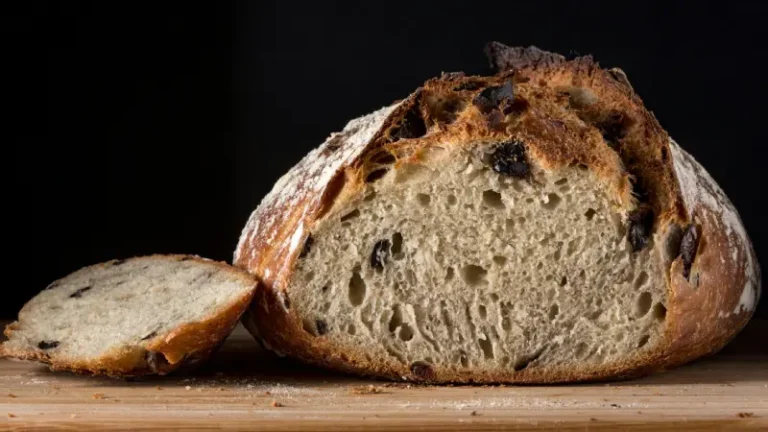
We’ve all experienced it: a beautiful, crusty loaf of artisanal bread turns into a dry, crumbly brick within a day or two. It’s easy to assume the bread has simply “dried out,” but from a food science perspective, something far more complex is happening.
The primary cause of staling is a process known as retrogradation. It is the natural chemical progression starch undergoes after baking as it cools and ages. Understanding this process explains not only why bread becomes firm, but also how to slow staling — and even partially reverse it.
The Starting Point: Gelatinization
To understand staling, we must begin in the oven. During baking, the starch granules in flour undergo starch gelatinization.
As dough heats, starch granules absorb water and swell. Their organized, semi-crystalline structure begins to break down. Amylose and amylopectin — the two primary components of starch — become dispersed in a disordered, gel-like state.
This gelatinized starch network is responsible for the soft, moist, flexible crumb of freshly baked bread. At this stage, the starch molecules are disorganized and loosely associated, holding water within the structure.
Fresh bread softness is, in large part, the result of this unstable, hydrated starch gel.
What Is Retrogradation?
As soon as bread begins to cool, the starch molecules start reorganizing. Retrogradation is the process by which gelatinized starch chains gradually realign and recrystallize into more ordered structures.
It happens in stages.
The Molecular Shift
Re-alignment:
Amylose chains begin to reassociate relatively quickly, forming tighter molecular bonds. Amylopectin follows more slowly over time.
Water Redistribution:
As starch chains move closer together, they squeeze out some of the water that was previously trapped within the gel network. This water migrates into other parts of the crumb or toward the crust.
Firming:
The newly formed crystalline regions create rigidity. The crumb becomes firmer, less elastic, and more crumbly. This structural change — not simple dehydration — is what we perceive as staleness.
Bread can stale even in sealed packaging where moisture loss is minimal. The texture change is primarily molecular.
The Reheating Effect
One of the most fascinating aspects of retrogradation is that it is partially reversible.
When stale bread is reheated, the added heat disrupts the crystalline bonds formed during retrogradation. The starch molecules return temporarily to a more disordered, gel-like state. Water that had migrated away can redistribute, softening the crumb.
This is why toasting or warming bread restores softness and flexibility — at least temporarily.
Pro Tip:
To revive a stale loaf, lightly mist the crust with water and place it in a 180°C oven for 5–10 minutes. The added moisture and heat help re-disrupt the starch crystals and restore a softer texture.
However, once the bread cools again, retrogradation resumes.
Factors That Influence Staling
The Refrigerator: The Enemy of Bread
One of the most common mistakes is refrigerating bread to “keep it fresh.” In reality, refrigeration accelerates retrogradation.
Starch recrystallizes most rapidly at temperatures just above freezing (around 0–10°C). The refrigerator provides nearly ideal conditions for starch molecules to reorganize efficiently.
As a result, bread stored in the fridge often becomes firm faster than bread stored at room temperature.
Freezing, however, slows retrogradation dramatically by halting molecular movement — making it the best option for long-term storage.
Ingredients and Structure
Several formulation factors affect the rate of retrogradation.
Fat and Sugar:
Enriched breads such as brioche stay soft longer because fats and sugars interfere with starch chain alignment. Fat molecules can physically limit reassociation, while sugars bind water and reduce mobility.
Acidity:
Sourdough breads often stale more slowly. The lower pH can modify starch interactions and may slightly delay recrystallization.
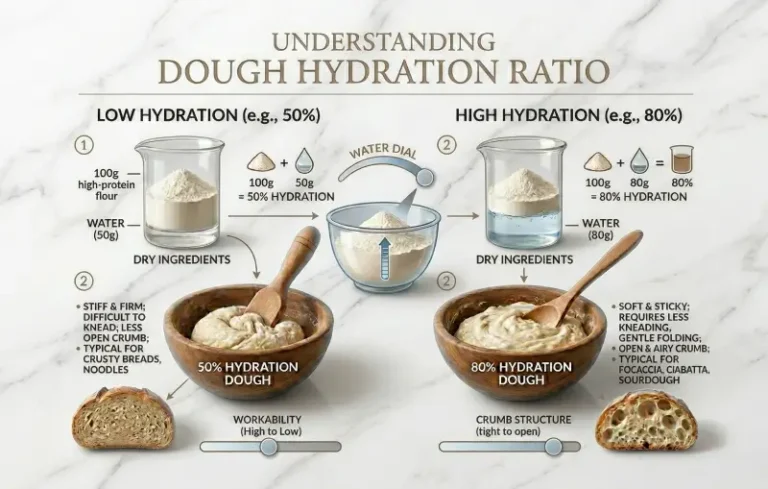
Hydration:
Higher moisture content provides more flexibility in the crumb structure, though it does not prevent retrogradation entirely. Eventually, all starch-based bread will firm as molecular reorganization progresses.
Retrogradation and Nutrition: Resistant Starch
Interestingly, retrogradation is not entirely negative.
When starchy foods such as bread, rice, or potatoes are cooked and then cooled, some of the reorganized starch becomes more resistant to digestion. This form is known as resistant starch.
Related article: Resistant Starch and Cooling Grains
Because its crystalline structure is tightly packed, digestive enzymes break it down more slowly. As a result:
- It behaves more like dietary fiber.
- It produces a lower blood glucose response.
- It can feed beneficial gut bacteria.
In this way, the same molecular process that makes bread stale can also improve certain nutritional properties.
Conclusion
Bread staleness is not simply about moisture loss. It is the result of starch molecules reorganizing into more stable, crystalline structures over time.
By understanding retrogradation, you can manage your bread more effectively: store it properly, freeze it when necessary, and use heat to temporarily reverse firming.
Staling is not failure — it is chemistry continuing its work long after the loaf leaves the oven.
Related article: How Carbohydrates Actually Build the Food We Love