Table of Contents
In the world of confectionery and baking, sugar is a structural chameleon. As you heat a sugar syrup, water evaporates, the sugar concentration increases, and the mixture moves through distinct “stages” that determine the final texture of your dessert. Read related article: Texture Engineering with Starch.
Understanding these temperatures is the difference between soft, chewy fudge and glass-like toffee.
The Science of the Syrup
When you dissolve sugar in water and bring it to a boil, you are managing the concentration of a solution. As heat drives off water through evaporation, the proportion of dissolved sugar increases. To see how these molecules look before they hit the heat, check out How Carbohydrates Actually Build the Food We Love.
Two important principles are at work:
- Evaporation: As water boils away, sugar molecules become more concentrated and more crowded within the solution.
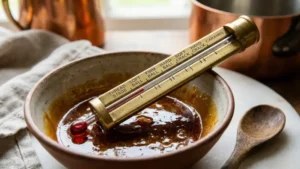
- Boiling Point Elevation: As sugar concentration rises, the boiling point of the syrup increases. This predictable relationship is why a thermometer is essential in candy making.
The higher the temperature climbs, the less water remains in the syrup—and the firmer the texture will be once it cools.
The Critical Sugar Stages
Each sugar stage corresponds to a specific temperature range and a characteristic behavior when a small amount of syrup is dropped into cold water.
Thread Stage (106°C – 112°C)
At this stage, the syrup is roughly 80% sugar.
- The Test: It forms thin, delicate threads that do not hold their shape.
- Culinary Use: Ideal for glazes, simple syrups, and candied fruit coatings.
Soft-Ball Stage (112°C – 116°C)
The syrup thickens further as water continues to evaporate.
- The Test: A small amount dropped into cold water forms a soft, flexible ball that flattens easily when removed.
- Culinary Use: Essential for fudge, fondant, and pralines.
Firm-Ball Stage (118°C – 121°C)
At this point, the syrup contains significantly less water.
- The Test: It forms a firm ball that holds its shape but remains pliable.
- Culinary Use: Commonly used for caramels and marshmallows.
Hard-Ball Stage (121°C – 130°C)
The sugar concentration now approaches the low-to-mid 90% range.
- The Test: The syrup forms a hard ball that resists flattening but is not yet brittle.
- Culinary Use: Used for nougat, divinity, and gummy-style confections.
Soft-Crack Stage (132°C – 143°C)
Very little water remains in the syrup.
- The Test: The syrup forms flexible threads in cold water that bend before breaking.
- Culinary Use: Ideal for taffy and butterscotch.
Hard-Crack Stage (149°C – 154°C)
At this stage, the syrup is approximately 98–99% sugar solids.
- The Test: It forms brittle threads that snap cleanly when bent.
- Culinary Use: The foundation for lollipops, brittle, toffee, and hard candies.
Beyond the Crack: Caramelization
Once temperatures exceed about 160°C, you move beyond concentration stages and into caramelization. This is the stage where you might follow a Caramel Sauce Temperature Guide to reach that perfect amber hue.
Here, sucrose molecules begin to break down and reorganize. This is a purely sugar-based reaction, distinct from the mallard reaction, (read Caramelization vs Maillard Reaction ) which requires proteins. If heated beyond roughly 175–180°C, the sugar begins to burn, developing bitter flavors.
Troubleshooting and Pro Tips
- Altitude Matters: Water boils at lower temperatures at higher elevations. Subtract approximately 1°C from target temperatures for every 1,000 feet (300 meters) above sea level.
- Avoid Crystallization: Undissolved sugar on the sides of the pot can trigger unwanted crystallization. Use a wet pastry brush to wash down the sides.
- The Cold Water Test: If you do not have a thermometer, drop a small amount of syrup into very cold water to observe its behavior.
Cooking sugar is an exercise in precision. Each temperature stage represents a specific concentration that determines the final texture of your confection.