Table of Contents
To the casual observer, bread is a simple mix of flour, water, salt, and yeast. But to a food scientist, a loaf of bread is a complex, solid-foam biological structure. The difference between a dense, chewy bagel and a light, airy brioche isn’t just luck—it is the result of manipulating the structural network of carbohydrates and proteins.
Here is a deep dive into the architecture of bread and the science that holds it all together.
1. The Scaffolding: Gluten and Starch
Bread structure relies on two primary “building materials” found in flour: Proteins (Gluten) and Carbohydrates (Starch).
The Gluten Network
When wheat flour is hydrated, two proteins—glutenin and gliadin—bond together to create gluten.
- Glutenin provides elasticity (the ability to snap back).
- Gliadin provides extensibility (the ability to stretch).
Together, they form a stretchy, rubbery web that acts like thousands of tiny balloons. This web is what traps the carbon dioxide gas produced by yeast. Without this protein “scaffold,” the gas would simply escape, and the bread would not rise.
The Starch Support
While gluten gets most of the credit, starch makes up the bulk of the bread’s volume. During baking, starch granules undergo Starch Gelatinization. They absorb water and swell, eventually “setting” to provide the rigid walls that prevent the loaf from collapsing once it leaves the oven.
2. Creating the “Foam”: Aeration
Bread is technically a solid foam. Creating this foam happens in three distinct stages:
- Mixing: As you knead, you aren’t just developing gluten; you are folding air into the dough. These tiny “seed” bubbles are what the yeast will eventually inflate.
- Fermentation: Yeast consumes simple sugars (from the breakdown of complex carbohydrates) and exhales CO2. This gas migrates into the air bubbles created during mixing, causing the dough to expand.
- Oven Spring: In the first few minutes of baking, the heat causes the gas inside the bubbles to expand rapidly. Simultaneously, the water in the dough turns to steam, providing a final, dramatic burst of volume.
3. The Crumb: Open vs. Closed
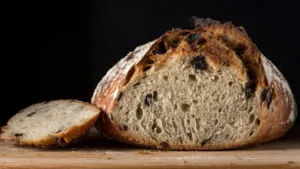
The “crumb” refers to the pattern of holes inside the bread. The architecture of the crumb is heavily influenced by Hydration Ratios in Dough.
- Open Crumb (Large, irregular holes): Found in ciabatta or sourdough. This is achieved through high hydration and gentle handling, which keeps the gluten network loose and allows bubbles to merge into larger pockets.
- Closed Crumb (Small, uniform holes): Found in sandwich bread or brioche. This is achieved through lower hydration and more intense kneading, which creates a strong, tight network with many small, reinforced bubbles.
4. The Crust: A Story of Heat and Sugar
The exterior of the bread is a different structural environment altogether. Because the surface is exposed to the highest heat and dries out the fastest, two chemical reactions occur:
- The Maillard Reaction: The reaction between sugars and amino acids that creates the savory, brown crust.
- Caramelization: The browning of residual sugars.
For a deeper look at this process, check out topic Caramelization vs Maillard Reaction.
Pro Tip: Steam in the oven keeps the surface of the dough moist for longer, allowing the bread to expand fully before the crust “sets.” This results in a thinner, crispier crust.
5. Factors That Alter Structure
Different ingredients act as “structural modifiers”:
- Fats (Butter/Oil): Fats “shorten” the gluten strands (hence the term shortening), leading to a more tender, less chewy structure.
- Acidity: In sourdough, the lower pH slightly weakens the gluten but improves the shelf life by slowing down (Read: Retrogradation: Why Bread Goes Stale).
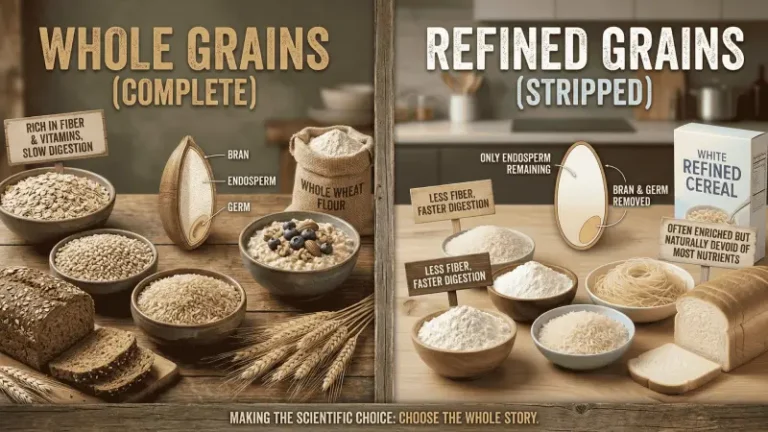
- Fiber: As explored in Whole Grains vs Refined Grains, bran particles can act like tiny “knives,” cutting through gluten strands and resulting in a denser loaf.
Conclusion
Understanding bread structure is about mastering the balance between the strength of the gluten and the pressure of the gas. When you control the hydration, the fermentation time, and the oven temperature, you are acting as an architect of carbohydrates.
Related article: How Carbohydrates Actually Build the Food We Love