Table of Contents
Badam Halwa is widely considered the “King of Indian Sweets,” known for its rich, velvety texture and the opulent aroma of pure ghee and saffron. This detailed guide demonstrates how to achieve the perfect, non-sticky, melt-in-the-mouth consistency that defines professional-grade Halwa.
Ingredients and Measurements
To achieve the authentic taste and texture, precise measurements are essential:
- Almonds (Badam): 500g (half a kilo)
- Sugar: 750g (for a standard sweet profile)
- Pure Ghee: 500g (equal to the weight of almonds)
- Milk: Used for soaking and grinding to a smooth paste
- Saffron (Kesar): A generous pinch soaked in warm milk for color and aroma
- Water: For preparing the sugar syrup
The Step-by-Step Preparation
1. Preparing the Almonds
The process begins with soaking the almonds in hot water for about 2–3 hours. This allows the skins to be easily peeled off. Once peeled, the almonds are ground into a paste. For a traditional texture, the paste should be slightly grainy (“daanedar”) rather than a completely smooth liquid. It is emphasized to use a small amount of milk during grinding to maintain the richness.
2. Cooking the Base
The cooking starts by combining the almond paste with sugar and a little water in a heavy-bottomed pan. Initially, the mixture will be thin as the sugar melts. It is crucial to cook this on a medium-low flame, stirring constantly to prevent the almond paste from sticking to the bottom or burning.
3. The Art of Adding Ghee
The secret to the perfect Halwa lies in the gradual addition of ghee. Instead of pouring it all at once, add a few tablespoons at a time. As you stir, the almond mixture will absorb the ghee. Once the mixture starts to release the ghee back and no longer absorbs it, you know it is nearing completion.
4. Infusing Flavor and Color
During the middle of the cooking process, the saffron-infused milk is added. This provides a natural, beautiful golden hue and an unmistakable royal fragrance that chemical colors cannot replicate.
5. Achieving the “Halwa” Consistency
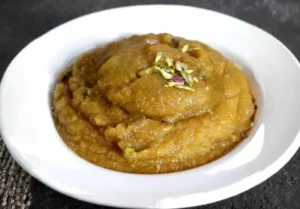
The Halwa is ready when it begins to leave the sides of the pan and forms a single, cohesive mass. It should have a glossy sheen from the ghee. When you take a small piece and roll it, it should not stick to your fingers.
Conclusion
Badam Halwa is a labor of love. While it requires patience and constant stirring, the result is a dessert that is unmatched in its richness. Served warm, often garnished with additional almond slivers, it remains the ultimate delicacy for celebrations and special occasions.